Description
Between 1940 and 1950, the growth hormone somatotropin was identified and researched, leading to the discovery of somatomedins — serum factors with insulin‑like activity that were later classified as insulin‑like growth factors (IGFs) because of their structural and functional similarities to insulin. Subsequent research into insulin‑like growth factors generated variants designed to improve stability and activity. One such variant is Receptor Grade IGF‑1 LR3, which includes an additional arginine residue and a 13‑amino‑acid extension at the N‑terminus, giving it 83 amino acids compared to the 70 found in natural IGF‑1.
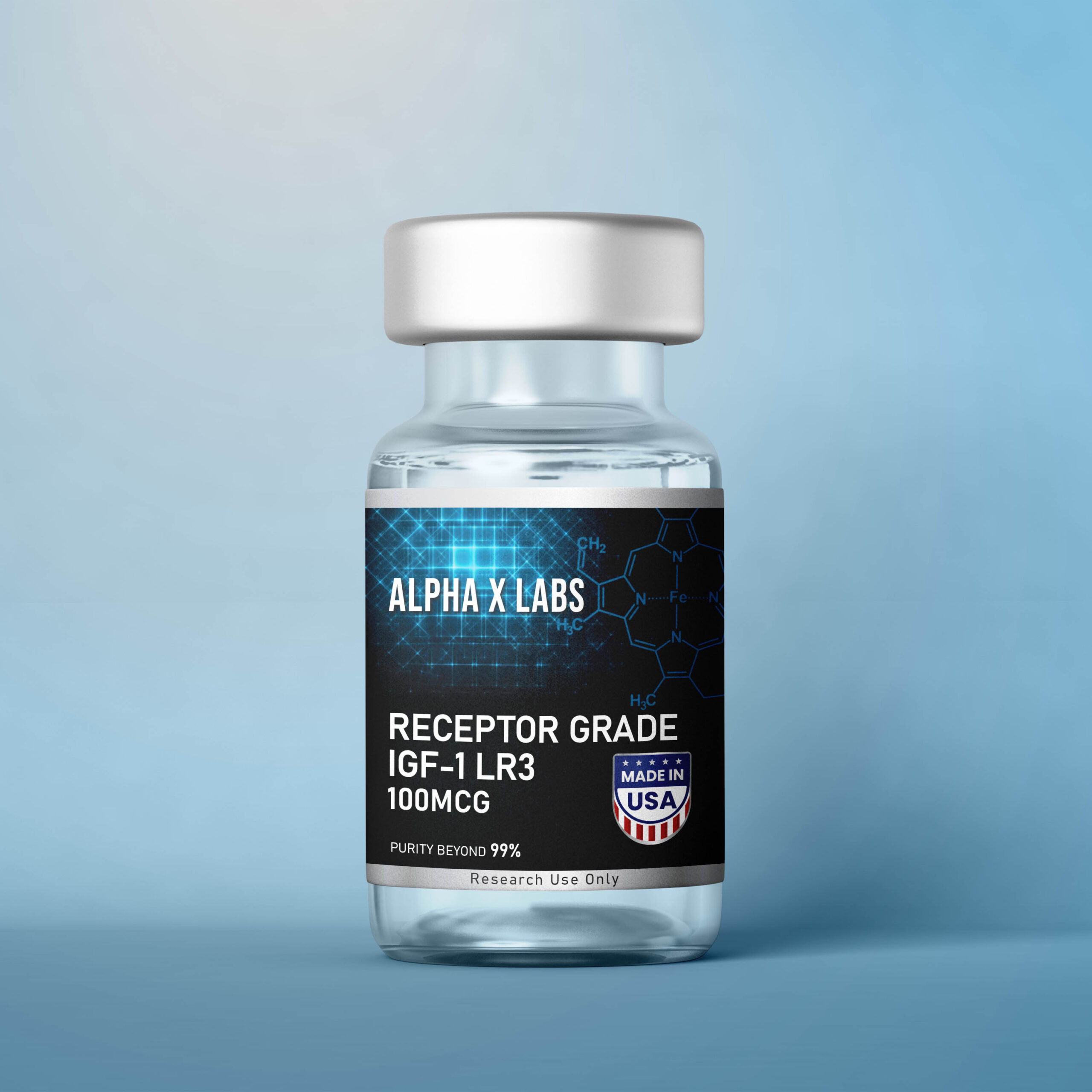
Receptor Grade IGF‑1 LR3 peptide, also known as Long arginine 3 IGF‑1 or LR3‑IGF‑1, is a synthetic polypeptide suggested to exhibit actions similar to natural insulin‑like growth factor‑1 (IGF‑1). IGF‑1 is a naturally produced protein that plays roles in regulating cell development and tissue maintenance. The LR3 modification is hypothesized to increase affinity for IGF receptors while reducing binding to IGF‑binding proteins (IGFBPs), potentially enhancing its availability in laboratory experiments.
Overview
IGF proteins exert potential biological actions primarily through binding to IGF‑1 receptors, although IGF‑binding proteins can modulate their availability and activity. Receptor Grade IGF‑1 LR3 is produced at higher purity than lower grades (such as media grade analogs), which can be important for controlled research applications where consistency and purity may influence study results.
Chemical Makeup
Molecular Formula: C₄₀₀H₆₂₅N₁₁₁O₁₁₅S₉
Molecular Weight: 9117.5 g/mol
Other Known Titles: Long‑Arg3 Insulin‑Like Growth Factor‑I, Insulin‑Like Growth Factor long chain R3
Research and Experimental Context
Receptor Grade IGF‑1 LR3 Peptide and Cellular Anabolism
Research on IGF‑1 LR3 in laboratory models suggests that, in some cases, this analog may induce greater anabolic effects compared to native IGF‑1, potentially due to its reduced binding to IGF‑binding proteins and increased availability to interact with receptors. Some experimental studies in animal models report potentially enhanced signals for anabolic processes such as increased protein synthesis and improved nitrogen retention over native IGF‑1, although mechanisms and effects can vary.
Receptor Grade IGF‑1 LR3 Peptide and Tissue Distribution
In murine study settings, IGF‑1 LR3 has been observed to distribute into tissues such as kidneys, ovaries, and adrenal glands more readily, a pattern that may result from its decreased binding to IGFBPs compared to native IGF‑1. These differences could influence how the peptide interacts with cell receptors and tissues in experimental models, impacting study outcomes.
Receptor Grade IGF‑1 LR3 and Metabolic Signaling
Some research indicates that IGF proteins — including analogs like IGF‑1 LR3 — may engage multiple intracellular signaling pathways (such as PI3K and AMPK) that contribute to cellular growth, glucose uptake, and energy metabolism in research settings.
Receptor Grade IGF‑1 LR3 peptide is available for research and laboratory purposes only. Please review and adhere to our Terms and Conditions before ordering.