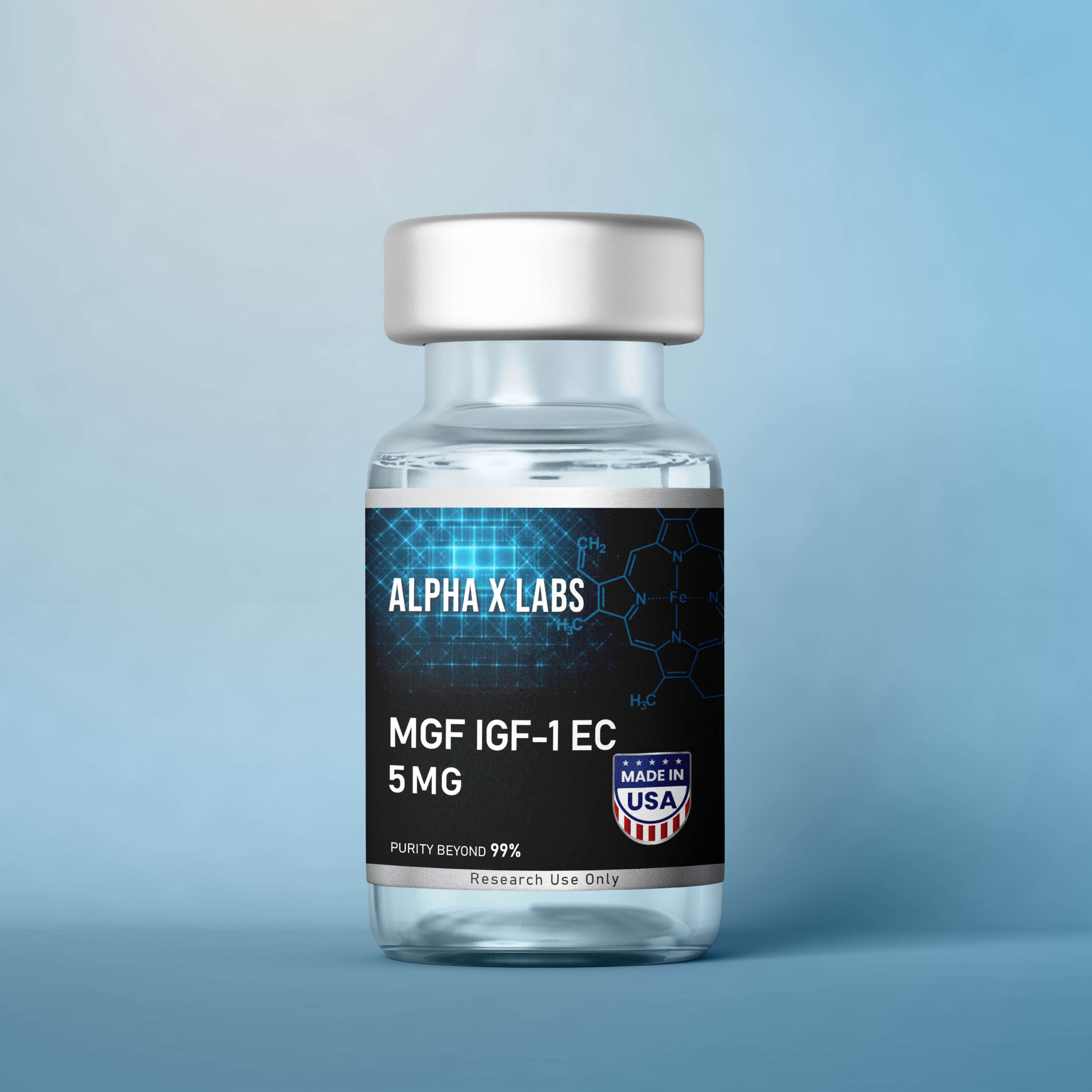
Description
MGF IGF‑1 Ec is the Mechano Growth Factor (MGF) domain made of 24 amino acids, which have been cleaved from the 110 amino acids of IGF‑1 Ec alongside other important molecules such as IGF‑1 (70 amino acids). Thus, MGF IGF‑1 Ec corresponds to the C‑terminal 24 residues of the IGF‑IEb/Ec pro‑peptide. According to research, the peptide fragment does not measurably induce IGF‑1 receptor tyrosine phosphorylation, and does not activate insulin receptors. Instead, the peptide appears to have potential to function as an IGF‑related peptide that bypasses classical IGF‑1 receptor activation and instead may signal preferentially through ERK pathways, exerting an anabolic potential towards a variety of cell cultures, especially muscle cells.
Chemical Makeup
Other Known Titles: Mechano‑Growth Factor, MGF‑Ct24E
Molecular Weight: 2971.99 g/mol
Molecular Formula: C124H204N42O41S1
Research and Clinical Studies
MGF IGF‑1 Ec and Muscle Cell Hypertrophy
Most of the research on MGF IGF‑1 Ec fragments revolved around muscle cells. One of the most important experiments on the peptide was conducted by Li et al., and suggests that the peptide apparently supports muscle cell hypertrophy. Interestingly, it appears to achieve that by activating Erk5 and Erk1/2 while only weakly and transiently engaging Akt, and it may do so without detectable IGF‑1 receptor tyrosine phosphorylation. This profile suggests potential implications of the peptide in studies conducted in laboratory settings aiming to dissect non‑canonical, Erk5‑centered pathways downstream of IGF‑1‑derived products, separate from the typical IGF‑1–Akt proliferative axis.
MGF IGF‑1 Ec and Muscle Cell Aging
Kandalla et al. also suggest that MGF IGF‑1 Ec may act as a modulator of cellular aging in muscle cells. In myoblasts derived from young satellite cells, repeated short exposures to MGF IGF‑1 Ec seemed to mitigate cellular aging for longer in the cell cultures observed in the study. These exposed cells were able to go through slightly more rounds of division, and, importantly, a larger share of them were still actively dividing even after many cycles of growth.
MGF IGF‑1 Ec and Muscle Cell Fibrosis
Another team of researchers led by Liu et al. suggests that the peptide may reduce histological fibrosis and lower early expression of collagen I and III. This suggests the peptide may have an anti‑fibrotic potential in injured muscle cells. In parallel, MGF IGF‑1 Ec appeared to decrease the expression of muscle cell inflammatory cytokines (TNF‑α, IFN‑γ, IL‑1β, and TGF‑β), chemokines (CCL2, CCL5, and CXCR4), oxidative stress factors (gp91phox) and matrix metalloproteinases (MMP‑1, MMP‑2, MMP‑9, MMP‑10, and MMP‑14), thus hinting at diminished NADPH oxidase‑related oxidative stress.
MGF IGF‑1 Ec and Muscle Cell Death
Experiments have also explored MGF IGF‑1 Ec as a potential modulator of cellular death. According to researchers, the anti‑apoptotic potential of the peptide was observed in mammalian myocyte cultures exposed to low oxygen environments in laboratory settings. Researchers observed less DNA fragmentation and increased expression of the pro‑survival gene Bcl‑2 compared with hypoxic control cells, positioning MGF IGF‑1 Ec as a potential research reagent for reducing apoptosis in stressed muscle cells.
MGF IGF‑1 Ec and Cartilage Cells
Further research suggests that MGF IGF‑1 Ec may support several key processes around defect zones that form when cartilage cells are mechanically overloaded or otherwise stressed. In progenitor cell cultures, the peptide apparently potentiated TGF‑β3‑induced chondrogenesis, supporting Col2 and aggrecan expression while suppressing Col1, indicating potential relevance in models of cartilage matrix quality. It was also suggested to reduce pro‑fibrotic and catabolic markers while increasing processes tied to cell migration and cytoskeletal reorganization.
This peptide is available for research and laboratory purposes only. Please review and adhere to the site’s Terms and Conditions before ordering.