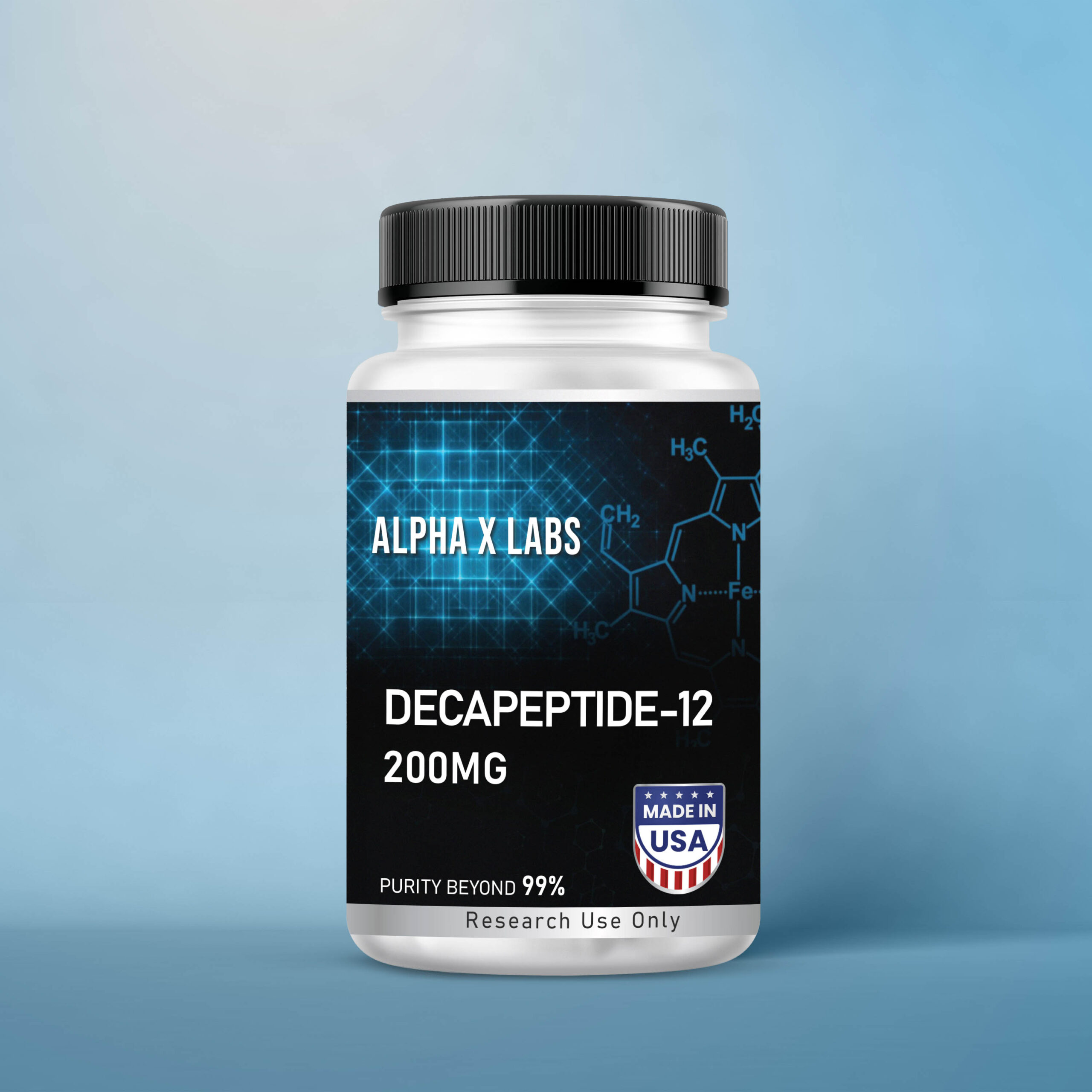
Description
Decapeptide-12 is a synthetic peptide that is composed of 10 amino acids. Its developers and subsequent researchers have suggested that Decapeptide-12 may potentially inhibit melanin production in the skin by suppressing the activity of tyrosinase, an enzyme involved in the synthesis of melanin. Decapeptide-12 does not appear to mimic any naturally occurring peptide. Rather, it was designed and synthesized to exhibit specific properties. Decapeptide-12 is primarily researched in reducing melanin production and hyperpigmentation. It has also been studied for its potential impact on cell growth, differentiation, and mitigating cell aging. However, more research is needed to fully understand the potential properties and results of Decapeptide-12 experiments in these contexts.
Chemical Makeup
Molecular Formula: C₆₅H₉₀N₁₈O₁₇
Molecular Weight: 1311.46 g/mol
Overview and Mechanisms of Action
As mentioned, Decapeptide-12 is posited to work primarily by inhibiting melanin synthesis, also known as melanogenesis. Melanin synthesis is suggested to be a complex biochemical pathway that may occur within specialized cells in the skin called melanocytes. Tyrosinase is posited to play a pivotal role in this pathway as it appears to catalyze the first two steps in melanin production: the hydroxylation of tyrosine to DOPA (3,4-dihydroxyphenylalanine) and the oxidation of DOPA to DOPAquinone. These reactions are suggested to be essential for the subsequent production of eumelanin and pheomelanin, the two main types of melanin pigments. Decapeptide-12 may act by potentially inhibiting tyrosinase activity. While the precise molecular mechanisms are complex and involve multiple pathways, the basic understanding is that Decapeptide-12 may bind to specific sites on the tyrosinase enzyme or its mRNA, thereby blocking the enzyme’s ability to catalyze the critical reactions in melanin synthesis. This inhibition could occur through direct interaction with the enzyme, leading to a change in its structure and reduced catalytic efficiency. Alternatively, Decapeptide-12 might interfere with the enzyme’s gene expression, lowering the amount of functional tyrosinase produced in the melanocytes.
Research and Clinical Studies
Decapeptide-12 and Melasma
One clinical study aimed to evaluate the potential of Decapeptide-12 in test subjects with moderate to severe melasma, solar lentigines, periocular lines, and wrinkles. This 24-week experiment reported apparent improvements in all of the reported facial conditions among the 25 subjects, with sustained impact. Another clinical trial investigated the potential of Decapeptide-12 on mild-to-moderate melasma in 33 test subjects over 16 weeks. Results suggested a visible reduction in the appearance of melasma. Furthermore, one study reported a complete clearance of melasma in 25% of subjects after six weeks of Decapeptide-12 presentation. Decapeptide-12 also was reported by the researchers to exhibit an apparent impact in test subjects with Fitzpatrick phototype IV skin and moderate recalcitrant melasma. The researchers concluded that all subjects demonstrated statistically significant improvement in the appearance of melasma and overall facial aesthetics.
Decapeptide-12 and Post-Inflammatory Hyperpigmentation
A clinical case study on pigmented skin (Fitzpatrick skin type IV) indicated that Decapeptide-12 may possibly accelerate the clearance of post-inflammatory hyperpigmentation compared to placebo. The researchers suggest this might be due to the tyrosinase-inhibiting potential of Decapeptide-12.
Decapeptide-12 and Solar Lentigo
One study evaluated the impact of Decapeptide-12 on solar lentigines caused by chronic photodamage. The results reported that 38.5% of the models evaluated appeared to have achieved complete clearance of pigmentation and all subjects appeared to exhibit some improvement.
Decapeptide-12 and Cell Aging
Sirtuins are a family of genes involved in various cellular processes such as cellular metabolism, DNA repair, inflammation, and stress resistance. One study looked at the potential of Decapeptide-12 on sirtuin gene expression in keratinocyte progenitors. Researchers used RT-PCR to measure the impact of Decapeptide-12 on seven sirtuin genes after 72-hour incubation with various concentrations of Decapeptide-12. The results suggested that Decapeptide-12 possibly increased transcription of several sirtuin genes, including SIRT1, SIRT3, SIRT6, and SIRT7, with reportedly reduced cytotoxicity. In this study, Decapeptide-12 increased transcription of SIRT1 by 141 ± 11% relative to control cells, while SIRT3, SIRT6, and SIRT7 increased by 121 ± 13%, 147 ± 8%, and 95 ± 14%, respectively. SIRT1 with increased transcription could enhance cellular resilience against oxidative stress and inflammation, possibly delaying aging processes on a cellular level.
Decapeptide-12 is available for research and laboratory purposes only. Please review and adhere to our Terms and Conditions before ordering.