
Description
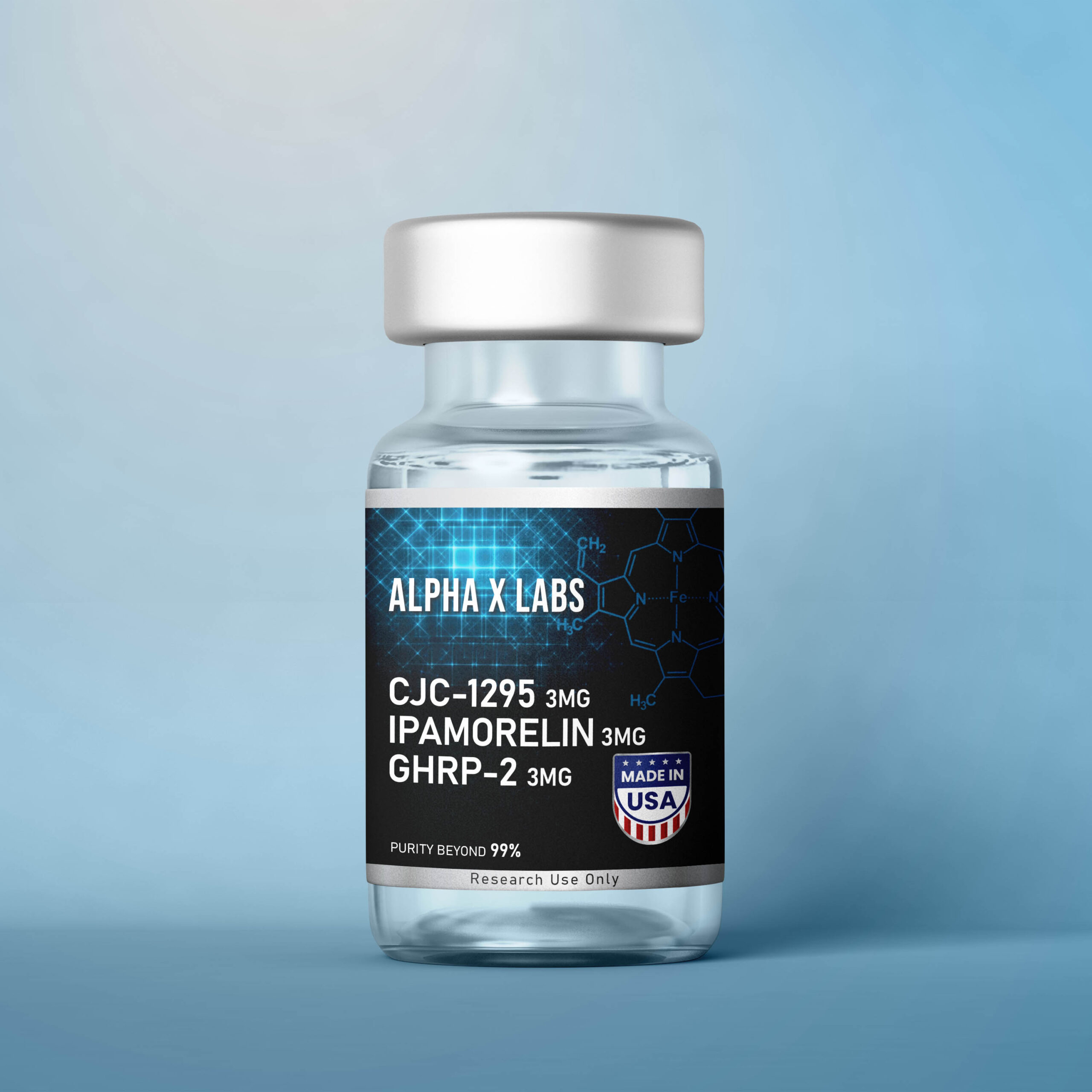
CJC-1295 (Mod GRF 1-29), Ipamorelin, and GHRP-2 are all synthetic peptides that are suggested by research teams to potentially stimulate the release of growth hormone. Anecdotal reports suggest that all three peptides appear synergistic when combined as a blend, potentially providing unique peptide action.
CJC-1295 (Mod GRF 1-29) is considered to be an agonist to the receptors for the native Growth Hormone-Releasing Hormone (GHRH). It is an analog of its truncated version called GHRH (1-29) which appears to potentially have the same affinity to the receptors. GHRH 1-29 is potentially the shortest functional sequence of GHRH made up of its initial 29 amino acids. CJC-1295 (Mod GRF 1-29) is a variation that has undergone tetrasubstitution and has been further modified with the addition of a drug affinity complex (DAC) element named N-epsilon-3-maleimidopropionamide. This component may, perhaps, bind to plasma proteins, possibly enhancing the pharmacokinetics of CJC-1295 (Mod GRF 1-29).
Ipamorelin is a pentapeptide that apparently mirrors the effects of the natural hunger hormone, ghrelin. This hormone may activate the ghrelin receptors in the pituitary gland, also known as the Growth Hormone Secretagogue receptors (GHS-R1a) which may trigger the release of growth hormone.
GHRP-2, also known as Growth Hormone Releasing Peptide 2, is a hexapeptide crafted from six distinct amino acids. It is a synthetic peptide analogous to the receptors of the naturally occurring peptide called ghrelin (aka the GHS-R1a receptors). Thus, GHRP-2 and Ipamorelin peptides appear to trigger GHS-R1a and potentially stimulate the release of growth hormone. However, they may also possibly increase food intake due to their reported effect on ghrelin receptors. This is why they are classified by researchers as Growth Hormone Secretagogues (GHSs).
Chemical Makeup
Molecular formula:
CJC-1295 (Mod GRF 1-29): C₁₅₂H₂₅₂N₄₄O₄₂
Ipamorelin: C₃₈H₄₉N₉O₅
GHRP-2: C₄₅H₅₅N₉O₆
Molecular weight:
CJC-1295 (Mod GRF 1-29): 3367.9 g/mol
Ipamorelin: 711.9 g/mol
GHRP-2: 817.9 g/mol
Other known titles:
Ipamorelin: Ipamorelin Acetate, IPA
GHRP-2: Pralmorelin, Growth hormone-releasing peptide-2
Research and Clinical Studies
CJC-1295 (Mod GRF 1-29), Ipamorelin, GHRP-2 Blend and Growth Hormone Deficiencies
Numerous clinical studies have been conducted on test subjects exhibiting growth hormone deficiency. These studies are recorded here for educational and research purposes; studies like these are ongoing and do not offer conclusive evidence of the peptide’s potential mechanism of action. In these clinical trials, peptides stimulating growth hormone release appeared to deliver some action in two ways – possibly either via stimulating the pituitary gland to release growth hormones, or possibly acting on the arcuate nucleus of the hypothalamus. While these peptides (including GHRP-2, Ipamorelin, and CJC-1295 (Mod GRF 1-29)) appeared to exhibit high releases of growth hormones, it remains unclear which of the two mechanisms worked. In addition, these studies suggested that these peptides may modulate food intake, cardiac tone, and sleep through apparently specific receptor agonistic action.
CJC-1295 (Mod GRF 1-29), Ipamorelin, GHRP-2 Blend, and Food Intake
In one clinical study, test subjects were presented with GHRP-2 and then presented with unlimited food supply to measure food intake. It was reported that the subjects with peptide presence ate approximately 36% more than the control subjects did. In addition, the growth hormone levels were reportedly increased in these subjects, suggesting the action the peptides had on both food intake and growth hormone levels. As per this study, the growth hormone release-stimulating peptides appeared to be a “valuable tool for investigating the effects on eating behavior.”
CJC-1295 (Mod GRF 1-29), Ipamorelin, GHRP-2 Blend, and Bone Mass
By apparently increasing growth hormone synthesis, all three peptides may potentially upregulate bone mineral density. Yet, Ipamorelin appears to be the most researched of these three peptides for this focus. In one study on murine subjects, the potential effects of Ipamorelin on bone mineral content were monitored using dual X-ray absorptiometry (DXA) and peripheral computed tomography, and results tentatively indicated potential increases in bone metrics, though density remained relatively stable.
CJC-1295 (Mod GRF 1-29), Ipamorelin, GHRP-2 Blend, and Muscle Mass
The main focus of research on this peptide blend has been on the potential synergy for increasing muscle mass. Studies on murine models with a GHRH gene deletion (GHRHKO) hinted that CJC-1295 (Mod GRF 1-29) may potentially have favorable action on lean mass. When influenced by this peptide, GHRHKO models appeared to retain typical lean weight and length compared with controls. Ipamorelin has also been suggested to potentially increase lean mass through positive nitrogen balance in preliminary studies.
This peptide blend is available for research and laboratory purposes only. Please review and adhere to our Terms and Conditions before ordering.