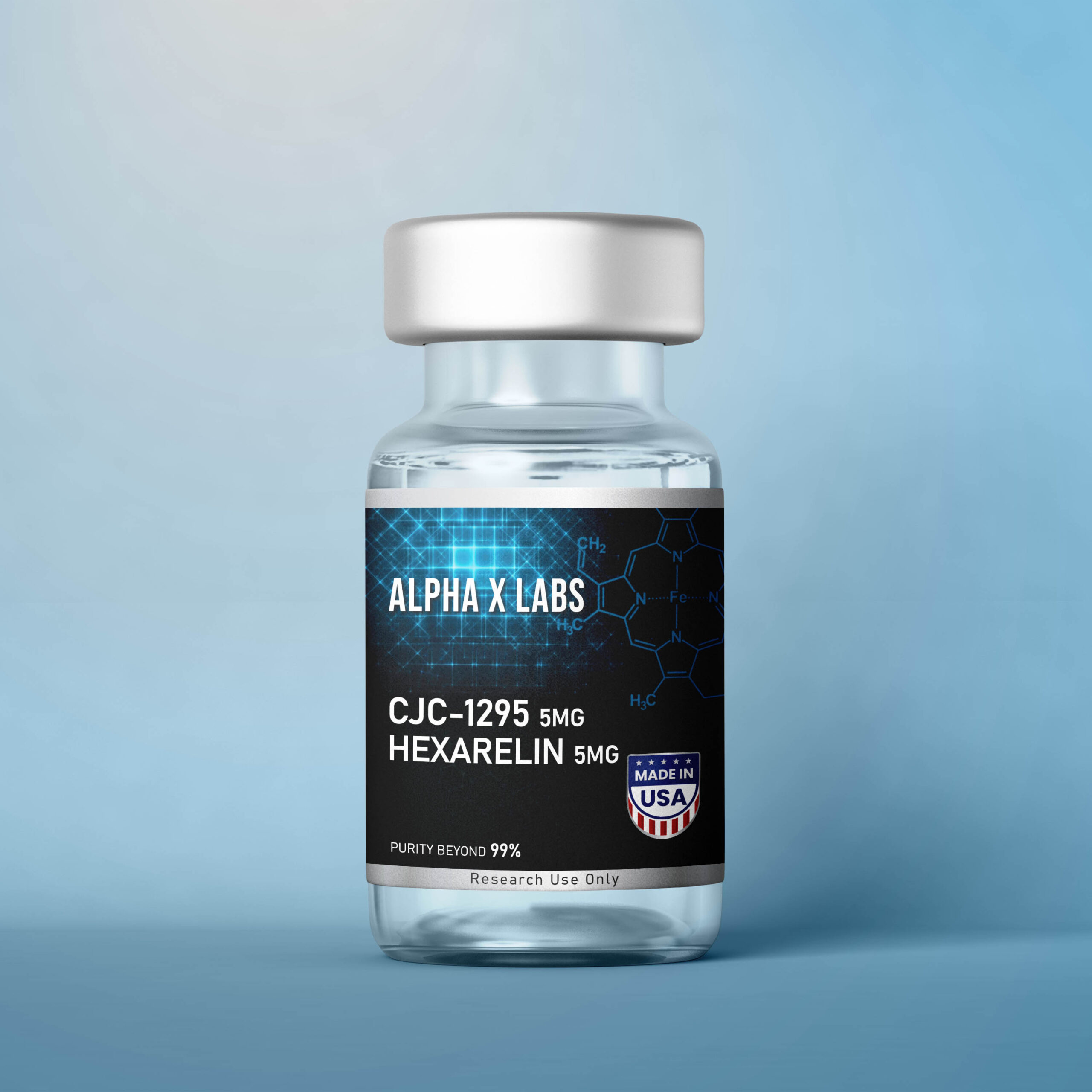
Description
CJC-1295 (no DAC) and Hexarelin are research peptides that have been studied by researchers in the interest of learning more about growth hormone synthesis by pituitary cells. Specifically, these peptides appear to interact with different receptors on anterior pituitary gland cells and stimulate the synthesis and release of this hormone.
Rather than interacting via the same receptors, CJC-1295 (no DAC) and Hexarelin belong to different classes of research peptides that interact with pituitary cells via different receptors. Previous research has suggested that simultaneous activation of both receptor types may initiate synergistic actions; hence, the combination of CJC-1295 (no DAC) and Hexarelin may be of interest to scientists.
Chemical Makeup
Other Known Titles:
• CJC-1295 (no DAC): Modified GRF 1-29
• Hexarelin: Examorelin, P-23905, MF-6003
Molecular Formula:
• CJC-1295 (no DAC): C₁₅₂H₂₅₂N₄₄O₄₂
• Hexarelin: C₄₇H₅₈N₁₂O₆
Molecular Weight:
• CJC-1295 (no DAC): 9 g/mol
• Hexarelin: 05 g/mol
Research and Clinical Studies
CJC-1295 (no DAC) Interactions with GHRH Receptors
CJC-1295 (no DAC) and Hexarelin appear to interact with pituitary cells via different receptors. CJC-1295 (no DAC) may interact with the cells via the GHRH receptor, which is posited to be the main type of receptor on these cells regulating growth hormone synthesis. Normally, these receptors respond to the endogenous growth hormone-releasing hormone (GHRH), which has a 44-amino-acid structure.
Researchers believe CJC-1295 (no DAC) may mimic that structure. This is suspected in part because the peptide consists of the first 29 amino acids from GHRH with four specific modifications. The first 29 amino acids are posited to retain a GHRH-receptor affinity while being a shorter molecule.
Hexarelin Interactions with GHS-R1a
Rather than a GHRH analogue, Hexarelin has been referred to by experts as a growth hormone secretagogue (GHS). This is a class of peptides that react with pituitary cells via a different set of receptors called the growth hormone secretagogue receptors 1a (GHS-R1a). Experimental work suggests that Hexarelin binding to these receptors may trigger a different signalling cascade that supports growth hormone release.
CJC-1295 (no DAC) & Hexarelin Potential on Hormone Synthesis
Experiments suggest that the growth hormone release induced by CJC-1295 (no DAC) and Hexarelin from pituitary cells may exceed the peaks typically observed in control settings. For example, data indicate that in some studies CJC-1295 (no DAC) increased growth hormone output by roughly 70–100% over 12 hours in laboratory settings. In addition, Hexarelin itself has been shown in experiments to drive growth hormone release, with peak levels observed within 30–40 minutes post-exposure.
Currently, there are no experiments that have evaluated a combination of CJC-1295 (no DAC) and Hexarelin directly, but research on blends of growth hormone-releasing hormone analogues with secretagogues suggests potential synergy when both receptor systems are engaged simultaneously.
This peptide blend is available for research and laboratory purposes only. Please review our Terms and Conditions before ordering.