Description
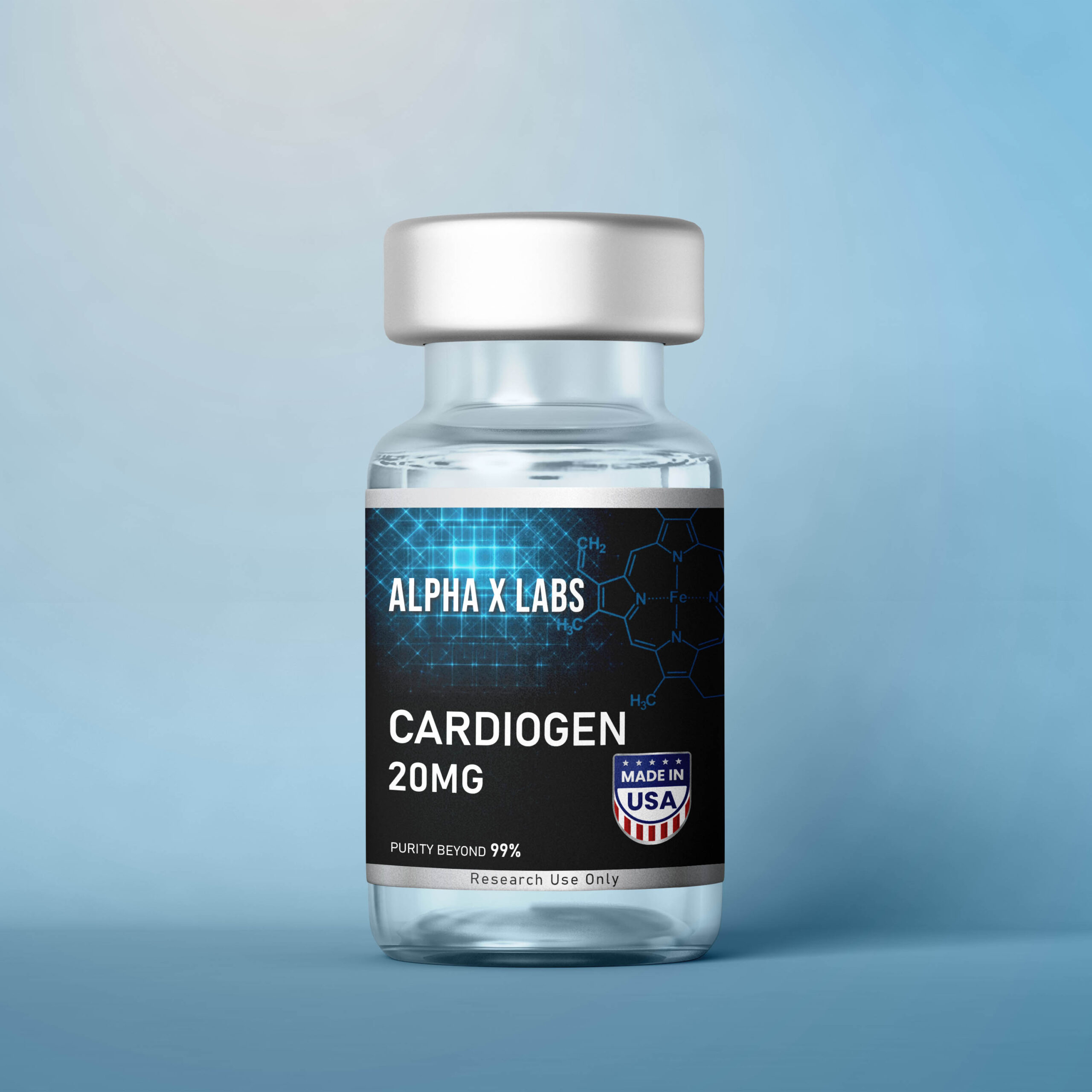
Cardiogen is considered a peptide bioregulator that possibly regulates fibroblasts, which are cells that play a role in scar formation and tissue repair. The peptide has been widely researched for its potential to interact with the tissues in the cardiovascular system. Still, recent research has suggested that it may also be functional in other tissues via influencing fibroblast activities. Furthermore, scientists believe Cardiogen may increase tumor cell apoptosis (programmed cell death).
Chemical Makeup
Molecular Formula: C18H31N7O9
Molecular Weight: 489.5 g/mol
Structure: H-Ala-Glu-Asp-Arg-OH
Other Known Titles: SCHEMBL3194515
Research and Clinical Studies
Cardiogen Peptide and Cancer Research
Researchers consider the peptide to be an apoptotic reductant in cardiac cells via possibly decreasing p53 expression and may exhibit opposite impacts on tumor cells. The p53 gene produces a protein found inside the nucleus of cells and is considered essential in controlling cell division and cell death. An experiment was conducted on murine models with M-1 sarcoma (indicating it has metastasized to other distant tissues and organs) to determine the tumor-modulating potential of Cardiogen, with apoptosis on tumor cells exceeding normal levels and considered uncontrollable. The results indicated a consequence of necrotic and hemorrhagic development and the improvement of tumor cell apoptosis. Researchers suggested: “The [concentration-dependent] inhibition of M-1 sarcoma growth after […] Cardiogen was caused by the development of hemorrhagic necrosis and stimulation of tumor cell apoptosis. The parameters of proliferative activity indicate that inhibition of tumor growth was not caused by the direct cytostatic effect of the [peptide] on the tumor. Morphological signs indicate a specific mechanism of Cardiogen action, realized through the vascular network of the tumor.”
Cardiogen Peptide and Prostate Cell Aging
According to researchers, Cardiogen may significantly increase the expression of signaling factors involved in the differentiation of prostate fibroblasts that typically decrease in senescent cultures. Because these signaling factors are considered to decline in aging and senescent fibroblasts, and Cardiogen appears to restore the levels of these factors, especially in senescent cell cultures, it is posited that the peptide may be a relevant candidate for further research in developing methods to address age-related dysfunctions of prostate cells.
Cardiogen Peptide and Cardiomyocytes Proliferation
Cardiogen may potentially be able to enter different parts of cells, specifically the cytoplasm, nucleus, and nucleolus. Additionally, researchers have hypothesized that Cardiogen might be able to hinder the breakdown of DNA fragments by endonucleases, which are enzymes involved in DNA processing. To explore this, a study was performed using murine embryonic fibroblast cells. These cells were grown in a laboratory setting, in a culture medium known as DMEM, enriched with approximately 10% embryonic calf serum, and kept in a humid environment. After about five days of growth, the cells were separated into two groups. The first group was left as is, serving as a control, while the second group was exposed to Cardiogen for approximately 30 minutes. It appears that in the cells cultivated with Cardiogen, there was a notable increase in the levels of certain proteins within the cytoplasm (such as actin, vimentin, and tubulin) and in the nucleus (specifically nuclear matrix proteins lamin A and C). Actin, vimentin, and tubulin are integral components of the cytoskeleton, the complex network of protein fibers that provide structure and shape to the cells. Actin forms microfilaments, vimentin offers mechanical support, and tubulin forms microtubules essential for intracellular transport and cell division. Further, lamin A and C are types of nuclear lamins providing structural support to the nucleus. These proteins increased roughly 2x-5x higher with Cardiogen than in the control group. These findings suggest that Cardiogen might be activating the expression of these cytoskeletal and nuclear matrix proteins.
Cardiogen Peptide and Cardiomyocytes Apoptosis
Researchers have suggested Cardiogen may increase cardiomyocyte proliferation while possibly decreasing fibroblast growth and development and scar formation, resulting in potential long-term and improved cardiac remodeling. Studies suggest that Cardiogen may reduce the expression of the p53 gene, resulting in a lower apoptosis rate of cardiomyocytes after injury. One study reported: “The tetrapeptide Cardiogen demonstrated the great stimulating effect on the proliferation both in tissues from young and old rats. The immunohistochemical study demonstrated a decrease of the p53 protein expression by Cardiogen action. This fact can testify that Cardiogen inhibits the apoptosis process in the myocardial tissue.” Another experiment in murine models of myocardial damage suggested that Cardiogen might significantly reduce mortality following this experimentally induced heart damage. Observations pointed to a threefold decrease in mortality compared to the control group. Additionally, this peptide may play a role in diminishing necrotic zones within the myocardial tissue, which are areas of cell death due to lack of blood flow. It also may help preserve glycogen content in myocardial cells, potentially enhancing the survival and function of cells after ischemia.
Cardiogen peptide is available for research and laboratory purposes only. Please review and adhere to our Terms and Conditions before ordering.